What Affects Wireless Charging Efficiency? 7 Key Factors and How to Improve It
 What Affects Wireless Charging Efficiency? 7 Key Factors and How to Improve It
Wireless charging has become an essential feature in smartphones, power banks, automotive accessories, and other consumer electronics.
As wireless charging technology continues to evolve from traditional Qi charging to Qi2 and the latest Qi2 25W standard, charging power is increasing rapidly. However, a higher rated output power does not automatically mean faster or more efficient charging.
The actual charging performance depends on multiple factors, including power input, coil alignment, charging distance, temperature, thermal management, device compatibility, and the design of the wireless charging system itself.
In this article, we explain the key factors affecting wireless charging efficiency and how manufacturers can improve charging performance through better product design.
1. What Is Wireless Charging Efficiency?
Wireless charging transfers electrical energy from a transmitter (TX) coil inside the charger to a receiver (RX) coil inside the smartphone or other device.
Unlike wired charging, there is no direct electrical connection between the charger and the device. Energy is transferred through electromagnetic induction.
This means that some energy is inevitably lost during the conversion and transmission process.
A simplified wireless charging system can be described as:
Power Adapter → Wireless Charger → TX Coil → Electromagnetic Energy → RX Coil → Battery
Every stage can affect the final charging performance.
Therefore, a 25W wireless charger does not necessarily mean that the smartphone will continuously receive 25W.
The actual charging power can be affected by the smartphone, charging protocol, temperature, coil alignment, power input, and other factors.
2. Seven Factors That Affect Wireless Charging Efficiency
2.1 Input Power
The power supplied to the wireless charger is one of the most important factors.
For example, if a wireless charger is designed to support high-power wireless charging but is connected to an insufficient power adapter, the charger may not be able to deliver its maximum rated output.
A properly matched power system should consider:
- Power adapter output
- USB-C PD capability
- Charging cable specifications
- Input voltage and current
- Power conversion efficiency
- Power consumption of the wireless charging system
For high-power wireless chargers, using a sufficiently powerful and compatible USB-C PD adapter and cable is essential.
RADERTECH Design Approach:
We can provide matched power adapters and charging cables for wireless charging products to help ensure that the wireless charger receives sufficient input power.
2.2 TX/RX Coil Alignment
The relative position of the transmitter coil (TX) and receiver coil (RX) has a significant impact on wireless power transfer.
When the two coils are properly aligned, energy can be transferred more efficiently.
When the receiver is significantly offset from the transmitter, coupling can decrease and energy losses may increase.
This is one of the key advantages of magnetic wireless charging.
The Wireless Power Consortium states that Qi2's Magnetic Power Profile enables more precise alignment between the phone and charger, helping reduce energy loss caused by misalignment.
Why magnetic alignment matters
Traditional flat wireless charging requires users to manually position the phone.
A magnetic charging system can automatically guide the phone into a more precise position:
Better Alignment → Better Coupling → Less Energy Loss → More Consistent Charging
This becomes increasingly important as wireless charging power increases.
RADERTECH Design Approach:
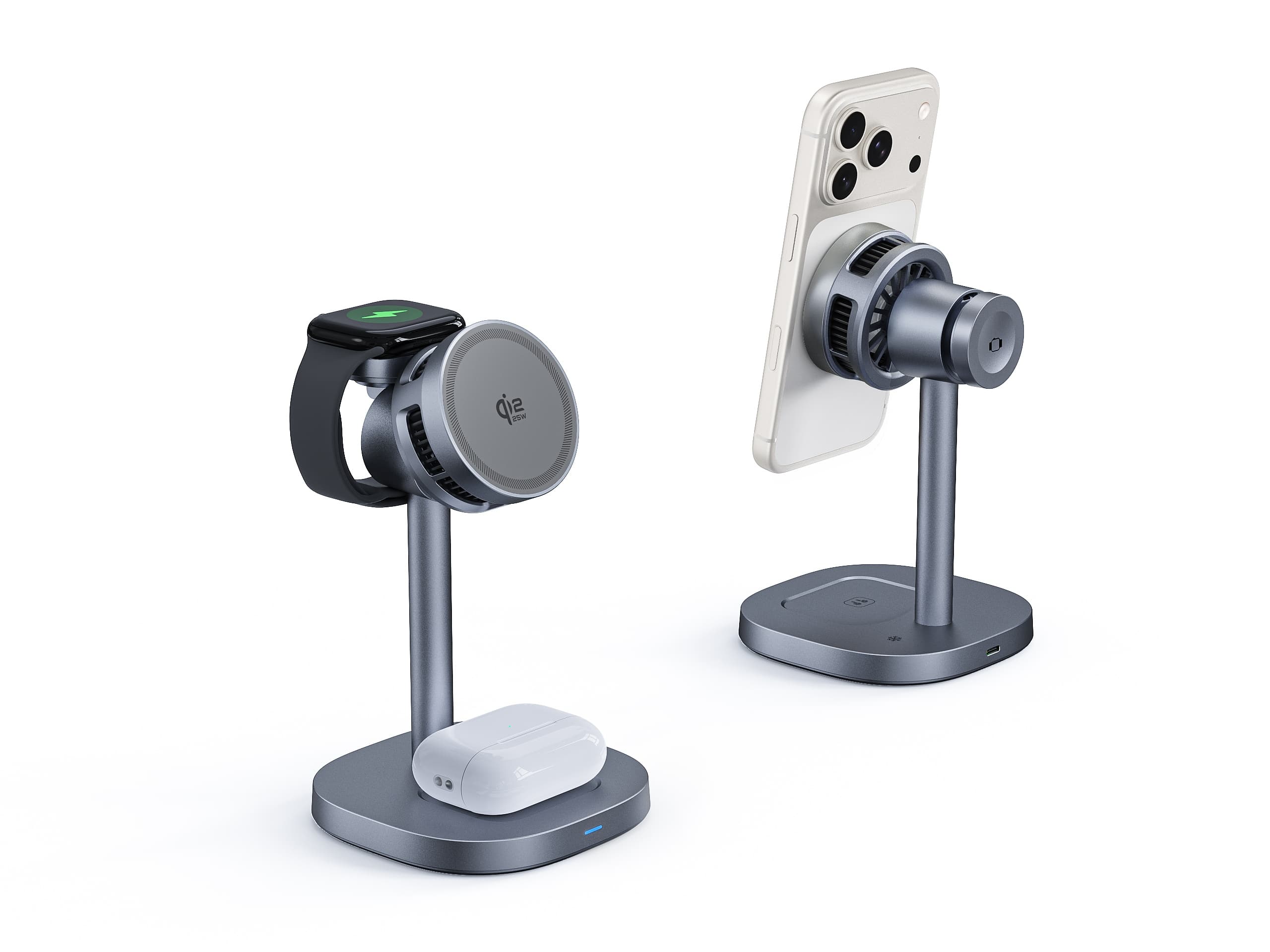
Our Qi2 and Qi2 25W wireless charging solutions use magnetic alignment to help maintain accurate TX/RX positioning.
[Link to RADERTECH Qi2 Magnetic Wireless Charger]
[Link to RADERTECH Qi2 25W Products]
2.3 Distance Between the TX and RX Coils
The distance between the transmitter and receiver coils also affects wireless power transfer.
In general, increasing the distance between the two coils makes energy transfer more difficult.
The effective distance can be affected by:
- Smartphone thickness
- Protective cases
- Magnetic rings
- Charger surface materials
- Internal structural components
- Coil positioning
For this reason, product designers need to carefully control the distance between the charging coil and the external charging surface.
A well-designed wireless charger should minimize unnecessary spacing between the TX coil and RX coil while maintaining sufficient mechanical protection and thermal isolation.
3. Temperature: One of the Most Important Factors
Temperature is particularly important for high-power wireless charging.
Wireless power transfer generates heat in several components, including:
- TX coil
- RX coil
- Power management components
- PCB
- Power conversion circuits
- Smartphone battery
As temperature increases, smartphones and charging systems may reduce charging power to protect the battery and electronics.
This means that thermal management can directly affect sustained charging performance.
For example:
Higher Temperature → Thermal Protection → Lower Charging Power → Longer Charging Time
Therefore, improving thermal management is not simply about making the charger cooler. It is about maintaining a stable temperature so that higher charging power can be sustained for longer periods.
4. How Can Wireless Chargers Improve Thermal Performance?
A well-designed wireless charger should establish an efficient thermal path from the heat-generating components to the external environment.
A typical thermal path can be designed as:
Coil → Thermal Interface Material → Heat Spreader → Housing → Air
Depending on the application and required charging power, different thermal solutions can be used.
Passive Cooling
- Aluminum alloy housing
- Graphite sheets
- Thermal silicone
- Copper heat spreaders
- Heat pipes
- Vapor chambers
- Larger internal heat dissipation areas
Active Cooling
- Miniature cooling fans
- Airflow channels
- Temperature sensors
- Intelligent fan control
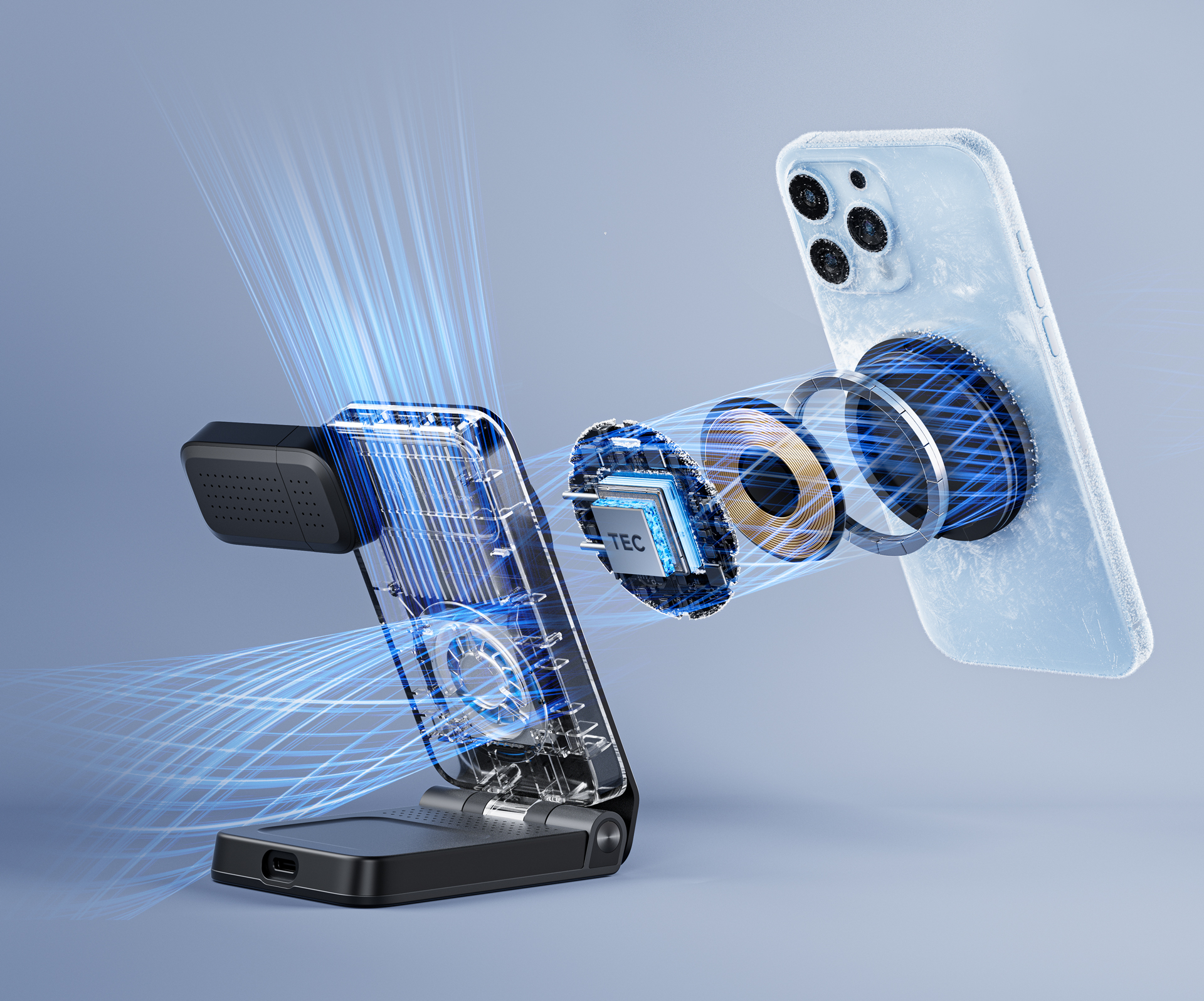
- Semiconductor / TEC cooling systems
For high-power wireless charging, combining several thermal technologies can provide better results than relying on a single material.
RADERTECH Design Approach:
For high-power wireless charging applications, RADERTECH can develop customized thermal solutions based on product structure, target charging power, size limitations, and application requirements.
[Link to RADERTECH Cooling Wireless Charger]
5. Active Cooling for High-Power Wireless Charging
As wireless charging power increases, thermal management becomes even more important.
For applications requiring sustained high-power wireless charging, active cooling can provide additional thermal performance.
Semiconductor / TEC Cooling
Thermoelectric cooling technology can actively transfer heat away from the charging area.
This approach can be considered for:
- High-power wireless chargers
- Qi2 25W products
- Wireless charging stands
- Magnetic power banks
- Automotive wireless chargers
Fan Cooling
A compact fan can increase airflow around the heat-generating components and accelerate heat dissipation.
However, fan-based products need to consider:
- Noise
- Dust protection
- Fan lifetime
- Airflow direction
- Internal airflow resistance
- Product thickness
For consumer products, the cooling system needs to achieve a balance between thermal performance, noise, reliability, size, and cost.
[Explore RADERTECH 25W Qi2.2 TEC Cooling Wireless Charger]
6. Automotive Wireless Charging: Using the Vehicle's Airflow
Automotive wireless charging introduces another important thermal challenge.
A smartphone placed inside a vehicle can already be exposed to high ambient temperatures, especially under direct sunlight.
Adding wireless charging heat to the system can further increase the temperature of the phone.
One potential solution is to combine wireless charging with the vehicle's existing air-conditioning airflow.
For example, an air-vent wireless charger can position the phone directly in the path of cool air.
This creates an additional cooling mechanism:
Vehicle AC Airflow → Phone / Wireless Charger → Heat Removal
For higher-power automotive wireless charging, product designers can go further by integrating dedicated airflow channels into the wireless charging structure.
RADERTECH Design Approach:
RADERTECH develops magnetic wireless car chargers with different mounting and cooling solutions, including solutions designed for high-power charging applications.
[Link to RADERTECH Cooling Fan Wireless Car Charger]
[Link to RADERTECH Qi2.2 TEC Cooling Car Charger]
7. Charging Protocol and Device Compatibility
Another important factor is compatibility between the:
Power Adapter + Wireless Charger + Smartphone
The maximum charging power is determined not only by the wireless charger but also by the charging protocol and the receiving device.
For example, a wireless charger may support a high maximum output, while a particular smartphone may support a lower wireless charging power.
Therefore:
Rated Charger Power ≠ Actual Smartphone Charging Power
The final charging performance depends on the complete charging system.
For OEM and ODM projects, product developers should evaluate the complete system rather than focusing only on the maximum wattage printed on the product specification.
8. Why Qi2 and Qi2 25W Matter
Qi2 introduced a major improvement to wireless charging through magnetic alignment.
The Wireless Power Consortium describes Qi2 as a standard designed to improve convenience, interoperability, charging efficiency, and charging performance. Qi2 originally supported 15W charging, while Qi2 25W was introduced in 2025 with nearly 70% more power than the original Qi2.
The importance of Qi2 25W is not simply the increase in power.
Higher charging power makes the entire charging system more demanding.
As charging power increases, manufacturers need to pay greater attention to:
- Coil efficiency
- Magnetic alignment
- Power conversion
- Thermal management
- Mechanical structure
- Temperature monitoring
- Power management
- Device compatibility
In other words:
Higher wireless charging power requires a more complete system design.
[Explore RADERTECH Qi2 25W Wireless Charging Solutions]
9. How RADERTECH Improves Wireless Charging Performance
At RADERTECH, we believe that high-performance wireless charging is not simply about increasing output power.
It requires a combination of:
1. Optimized Power Input
Properly matched power adapters, USB-C cables, and power management systems.
2. Precise Magnetic Alignment
Qi2 / Qi2 25W magnetic positioning helps maintain accurate TX/RX coil alignment.
3. Optimized Coil Design
Careful consideration of coil size, positioning, shielding, and internal structure.
4. Advanced Thermal Management
Depending on the application, solutions can include:
- Graphite
- Thermal silicone
- Aluminum structures
- Heat spreaders
- Heat pipes
- Vapor chambers
- Cooling fans
- TEC semiconductor cooling
5. Application-Specific Design
Wireless chargers can be optimized according to their intended environment.
For example:
Desktop Charger → Passive Thermal Management
Qi2 25W Charger → Enhanced Thermal Management
Magnetic Power Bank → Compact Heat Dissipation
Wireless Car Charger → Airflow + Active Cooling
This application-specific approach allows the charging system to achieve a better balance between performance, size, reliability, and cost.
10. The Future of High-Power Wireless Charging
Wireless charging is moving toward higher power, better alignment, improved thermal management, and smarter power control.
The development of Qi2 and Qi2 25W demonstrates this direction.
However, the future of wireless charging is not simply about achieving a higher peak wattage.
The real challenge is maintaining high and stable charging performance while controlling temperature, energy loss, product size, and reliability.
For OEM and ODM customers, this means that wireless charging products should be designed as a complete system rather than simply selecting a higher-power charging module.
Conclusion
Wireless charging efficiency is influenced by many factors, including:
- Input power
- Charging protocol
- TX/RX alignment
- Charging distance
- Device temperature
- Ambient temperature
- Protective cases and other physical barriers
- Thermal management
- Overall product architecture
Some factors are controlled by the end user, while many others can be optimized during product development.
For manufacturers, the most effective approach is to combine:
Efficient Power Input + Precise Magnetic Alignment + Optimized Coil Design + Advanced Thermal Management + Intelligent Power Control
Together, these technologies can help wireless charging products deliver more stable, efficient, and reliable charging performance.
RADERTECH provides OEM and ODM wireless charging solutions, including Qi2 / Qi2 25W magnetic wireless chargers, wireless charging stands, magnetic power banks, wireless car chargers, and customized cooling solutions.
If you are developing a new wireless charging product or looking for an OEM/ODM manufacturing partner, contact the RADERTECH team to discuss your product requirements.
Ready to Develop Your Next Wireless Charging Product?
Whether you are looking for a standard wireless charging solution or a fully customized OEM/ODM product, RADERTECH can support your project from product development to mass production.
[Explore RADERTECH Wireless Charging Solutions]